Description
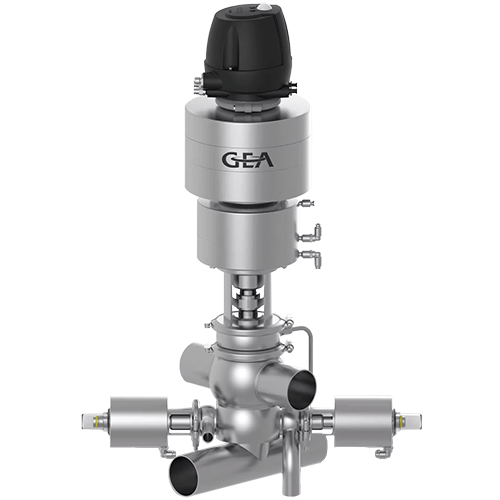
Aseptomag® LV Leakage Valves at a Glance
- Hermetic sealing by stainless steel bellow
- Uncompromising detection possibilities
- Easy and safe maintenance
- Ideal fit for UltraClean mixproof applications



Housing
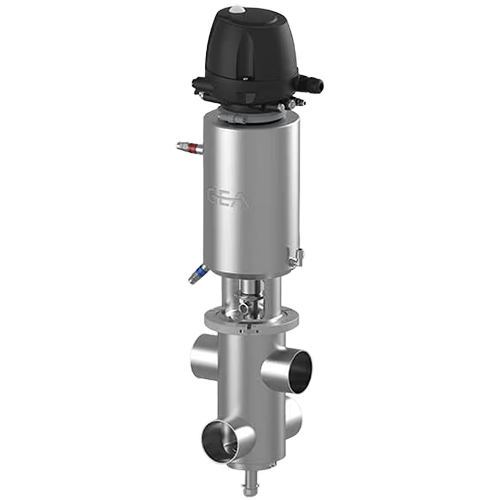
Housing for leakage valves are available with two, three, or four connection ports. The valves are produced with butt-weld connections by default. Mixed port connection sizes as well as various aseptic pipe connections are available upon request.
Internal Assembly
The internal assembly is equipped with a hard TEFASEP® seal for the axial, and an EPDM seal for the radial valve seat by default. In addition to the standard sealing material, an o-ring made of PTFE is optionally available for the axial valve seat seal.
Actuator
The pneumatic actuator for the leakage valves LV is made of stainless steel and designed to be spring-closing/air-opening (NC). In addition to the full stroke, the standard design allows both valve seats to be lifted independently (EA). Optionally, the valve can be configured with an actuator where only the radial valve seat A can be lifted independently (AZ).
Clamp
Due to its solid construction, the GEA Aseptomag® clamp enables a pressure stable and safe connection of the main components. The special design with three segments allows a service-friendly handling of the component, even under tight space conditions.
Feedback units
UltraClean leakage valves can be either equipped with open feedback units or T.VIS® feedback systems by default. Feedback units from third party suppliers can be mounted via special adaptors.
Options
Aseptomag® Leakage Valves can be executed with an additional steam connection (DA), which enables intermediate steam flushing of the leakage area independent from any seat lifting.
Furthermore, a mechanical backstroke barrier (RSS) can be mounted on top of the pneumatic actuator. This unit interacts with the radial valve seat A and is used as an additional safety feature to maintain the mixproof valve functionality even in the event of pressure hammers up to 50 bar.
UltraClean applications
Unlike the other valves in the Aseptomag® series, the main focus of the Leakage Valve LV and LVBS is not on purely aseptic but UltraClean applications. The most relevant product parameter for UltraClean applications is shelf-life. It is mostly determined by the pH-value and the aw-value of the product. In addition, sensory properties need to be considered as well as the logistical chain of distribution. One of the advantages of UltraClean processing is the reduced quantity of preservatives needed for maintaining the shelf-life of the product.
Application Examples