D-Tec® D/DV Double-Chamber Valves
Main Components
Housing
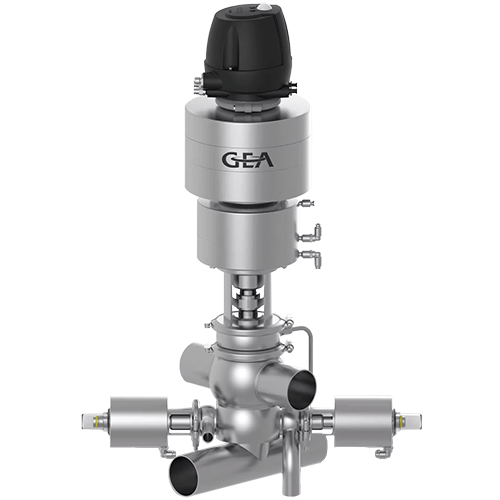
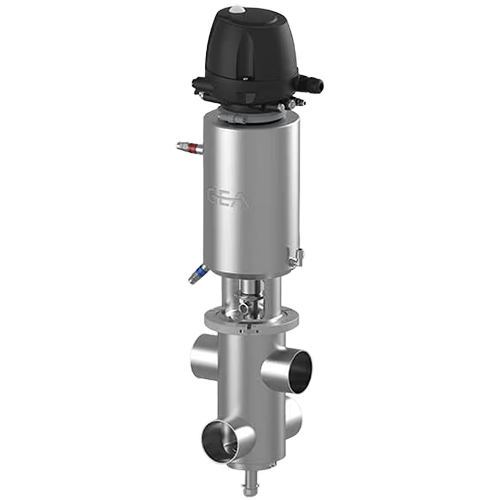
Housings for D-tec® double chamber valves are available with three or four connection ports. The valves are produced with standard butt-weld connections suitable for orbital welding by default. Mixed connection port sizes as well as various pipe connections are available upon request.
Internal assembly
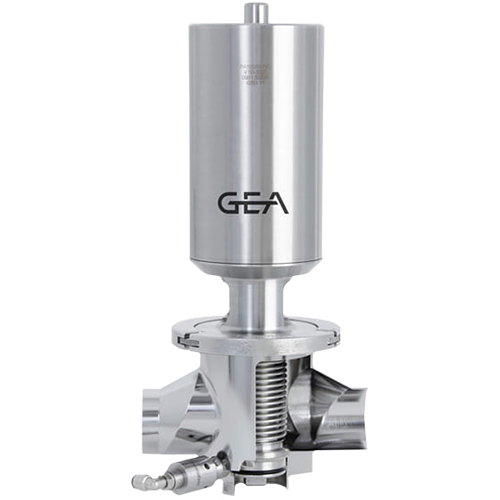
The hermetically sealing D-tec® stem diaphragm is the key element of every D-tec® valve. It is characterized by a very long service life, high dimensional stability with temperature resilience and cleanability. The internal assembly of a D-tec® double chamber valve includes two valve seat seals by default which can be equipped with soft-sealing (i.e. EPDM) or hard-sealing (TEFASEP® gold) materials. The lower valve seat corresponds with the nominal width of the valve.
Actuator
The main valve is equipped with two actuators by default. The main actuator is used to move the valve from its normally closed fail-safe position to the fully open position by applying pressurized air to the internal air supply. The lifting actuator on the other hand is used to lift the two valve seats of the main valve independently during CIP or SIP.
Lantern
The lantern connects the lift actuator with the product-wetted parts and simultaneously prevents the system from heat transfer between these two valve sections. The lantern has an important supporting and clamping function for the upper D-tec® stem diaphragm and is furthermore designed for a safe and easy visual detection of leakages.
Side valves
The sterile chamber includes an inlet and an outlet valve by default. The fail-safe position (NC or NO) of both side valves can be chosen independently from each other. The outlet can be equipped with integrated temperature probe which enables temperature measuring in the sterile chamber. In addition, the outlet can be configured with a divert valve to directly apply a sterile media also to the drain side of the valve.
Feedback units
D-tec® double chamber valves can be either equipped with open feedback units or T.VIS® control tops by default. The degree of automation at the valve can be adapted to customer needs by means of using one, two or three independent control tops.
UltraClean applications
The most relevant product parameter for UltraClean applications is shelf-life. It is mostly determined by the pH-value and the aw-value of the product. In addition, sensory properties need to be considered as well as the logistical chain of distribution. One of the advantages of UltraClean processing is the reduced quantity of preservatives needed for maintaining the shelf-life of the product.
Application Examples
- Brewery industry – Beer and mixed beer beverages (e.g. pure yeast cultivation and connection of sterile tanks and filling machines after sterilization)
- Beverage industry – Water-based mixed beverages (e.g. soft drinks, fruit juice and fruit-based beverages, concentrates, beverages with pulp)
- Dairy industry – Milk-based and lactic acid-fermented products (e.g. ESL milk, dessert products, crystallizing products such as lactose)
- Food and beverage industry – Sauces and delicacies (e.g. manufacture of basic fruit ingredients, incl. particulates such as nuts)